
Menton Travel Guide 2026: What to See and Do for a Weekend on the French Riviera
There are cities the French Riviera has swallowed whole in concrete and holiday apartments. Menton is not one of them. Located 55 kilometres east of Cannes, just steps from the Italian border, this town of 28,000 inhabitants has preserved what matters most: its pink and ochre facades reflected in the Mediterranean, its fragrant citrus gardens, its medieval lanes climbing towards the Saint-Michel Basilica like a neo-realist film set. You are still on the French Riviera here — but right on the edge of Liguria, and you feel it in the air, in the food, in the surnames of the elderly who still speak a little Mentonnais on market mornings.
Menton is called the "Pearl of France" — not as a marketing slogan, but as a geographical fact. The rocky frame of the Maritime Alps shelters it from cold northern winds, giving it the warmest microclimate in mainland France. In January, lemon trees are in bloom under a blue sky and temperatures reach 14 degrees C during the day. No wonder that Victorian English aristocrats and Russian nobility chose to winter here at the end of the 19th century — they had taste, and they had gout.
For a weekend from Cannes — or from anywhere on the French Riviera — Menton offers complete change of scene just 50 minutes away. This guide is written after many visits, some bowls of pasta just across the Italian border in Ventimiglia, and long conversations with locals who see their town changing quietly. Here is what you absolutely must see, taste, and experience — and the mistakes to avoid.
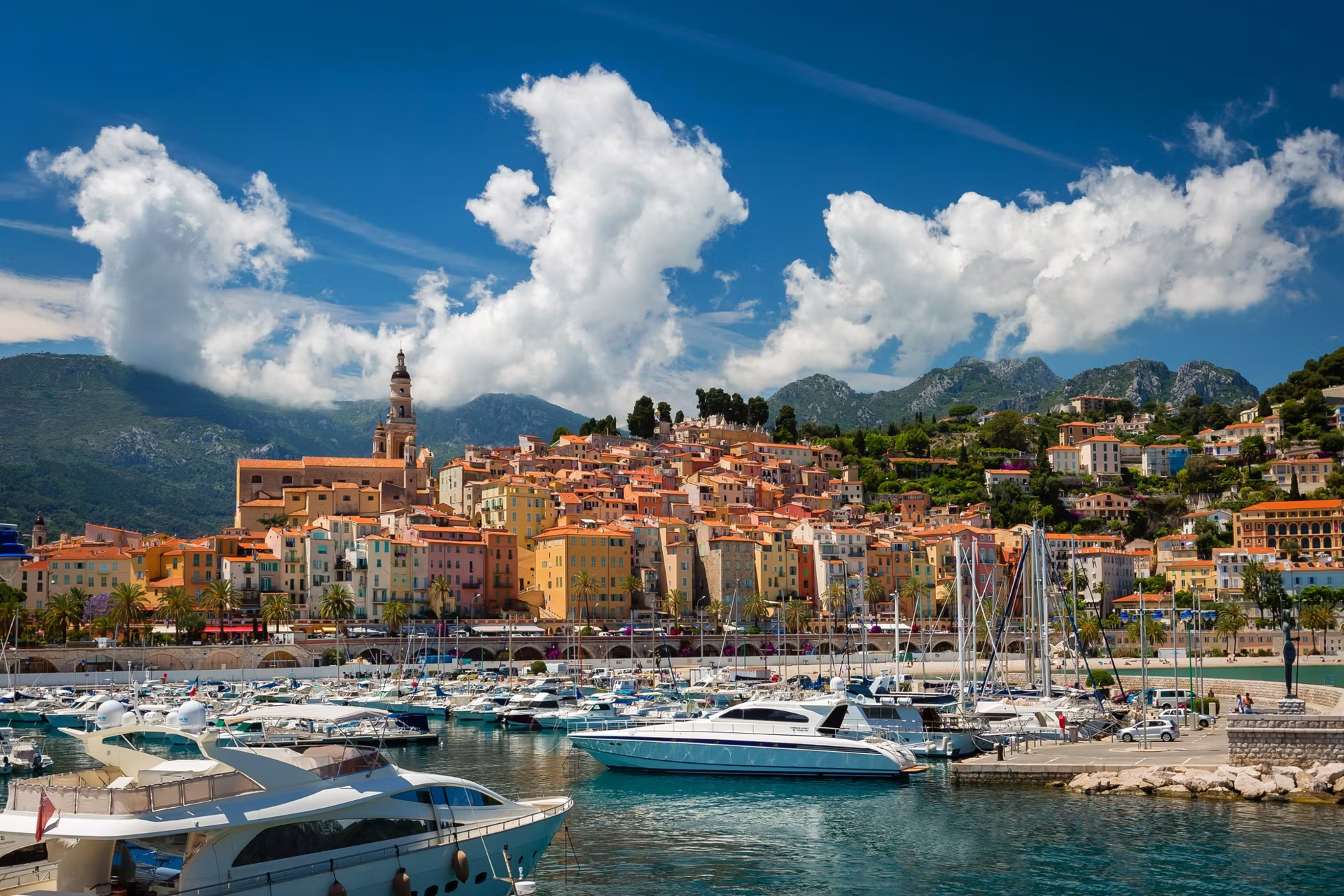
Menton from the sea: pastel facades stepping up to the Saint-Michel Basilica bell tower, with the Maritime Alps as a backdrop.
Menton at a glance: what makes this town different
Menton has none of Monaco's glamour, none of Nice's bustle, and none of Cannes' star power. What sets it apart is its preserved authenticity and a gentleness of pace that makes you smile. It is simultaneously deeply French and slightly Italian — the elderly still speak Mentonnais, a Ligurian dialect with a singing accent, and the local cuisine forever hesitates between the two cultures. Blette ravioli sits alongside socca and pissaladiere on restaurant menus.
The town is world-famous for its Lemon Festival, held every February-March and attracting 200,000 visitors to admire monumental sculptures made of citrus fruits. But Menton deserves to be visited outside festival season. It is often even better: the old town lanes remain accessible, the markets resume their daily rhythm, and the gardens bloom according to the seasons without the crowds.
Menton's history is particularly rich. An independent city-state from 1848 to 1861, it had its own parliament before rejoining France. This historical independence shows in the character of its residents: proud, open, but attached to their specificity. The Saint-Michel Basilica, the Palais Carnoles and the botanical gardens are witnesses to the prosperous era when European aristocrats and wealthy wintering guests invested their fortunes here.
What makes Menton ideal for a weekend is the density of what it offers within a small perimeter: pebble beaches with crystal-clear water, baroque old town, listed gardens, quality museums, Franco-Italian gastronomy — and Monaco just 15 minutes away.
Getting to Menton from Cannes
From Cannes, Menton is 55 kilometres along the A8 motorway — allow 50 to 70 minutes depending on traffic. The road follows the coastline, passes through Nice and climbs towards the Italian border along the Corniche de la Riviera, with its limestone cliffs plunging into cobalt-blue water. This is one of the most spectacular coastal drives in Europe.
The train exists — Cannes to Menton takes around 1h20 with a mandatory connection in Nice — but door-to-door from a Croisette hotel with luggage, you are often looking at 2h to 2h30. Car hire means dealing with the parking problem: Menton's old town has almost no on-street parking, and the only underground car park is far from the most interesting neighbourhoods.
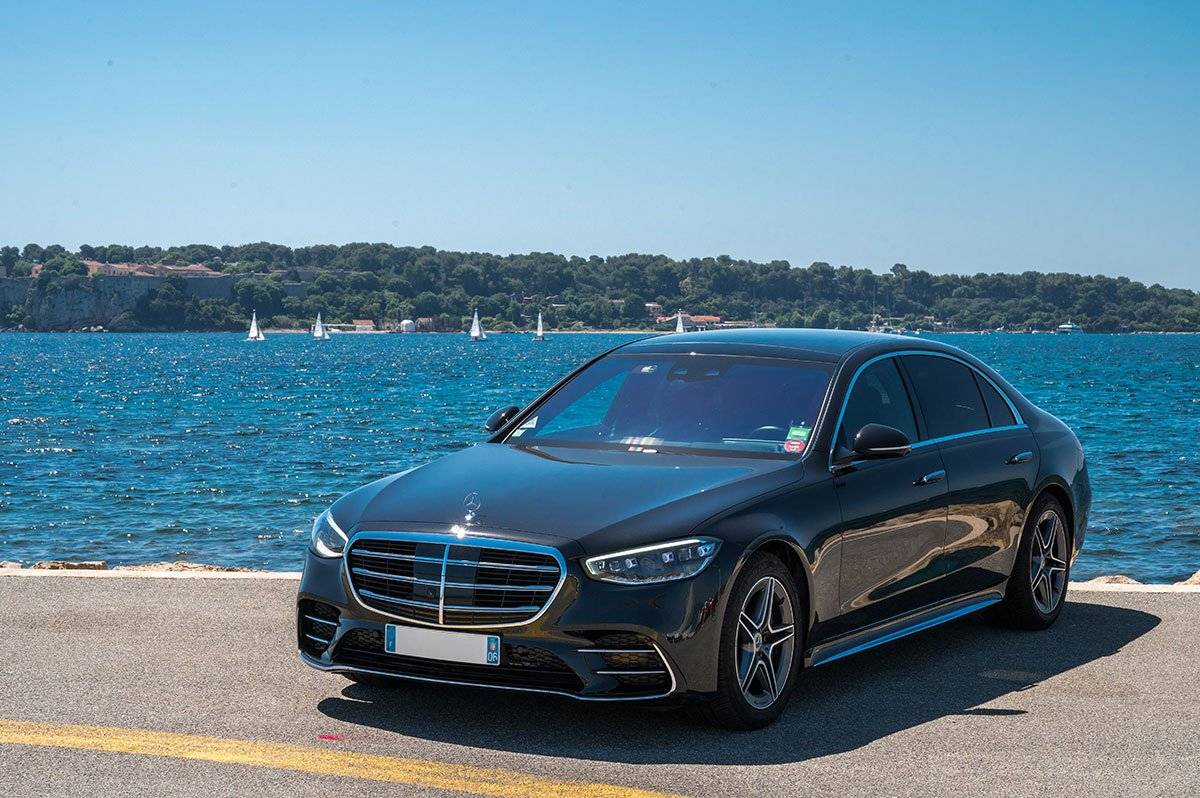
The solution we recommend to our clients: private chauffeur transfer Cannes to Menton. You leave from your hotel and are dropped directly at your address in Menton. No stress navigating the sinuous coastal roads — just the transition between two worlds from the back seat of a comfortable Mercedes. For the return, one message is enough for your chauffeur to collect you from wherever you finish.
Plug-In Cannes
Private Chauffeur Transfer Cannes to Menton
Fixed rate from 200 euros. Drop-off at your exact hotel or residence in Menton. Return journey arrangeable at the time of your choosing.
The Old Town: Menton's Baroque Heart
Menton's old town is one of the most beautiful on the Riviera — and one of the least known. Built into the hillside between the 14th and 18th centuries, it forms a stack of orange facades, Roman-tile rooftops, bell towers and staircase balustrades. In the morning, before tourist coaches arrive, the lanes smell of coffee and bread fresh from the ovens.
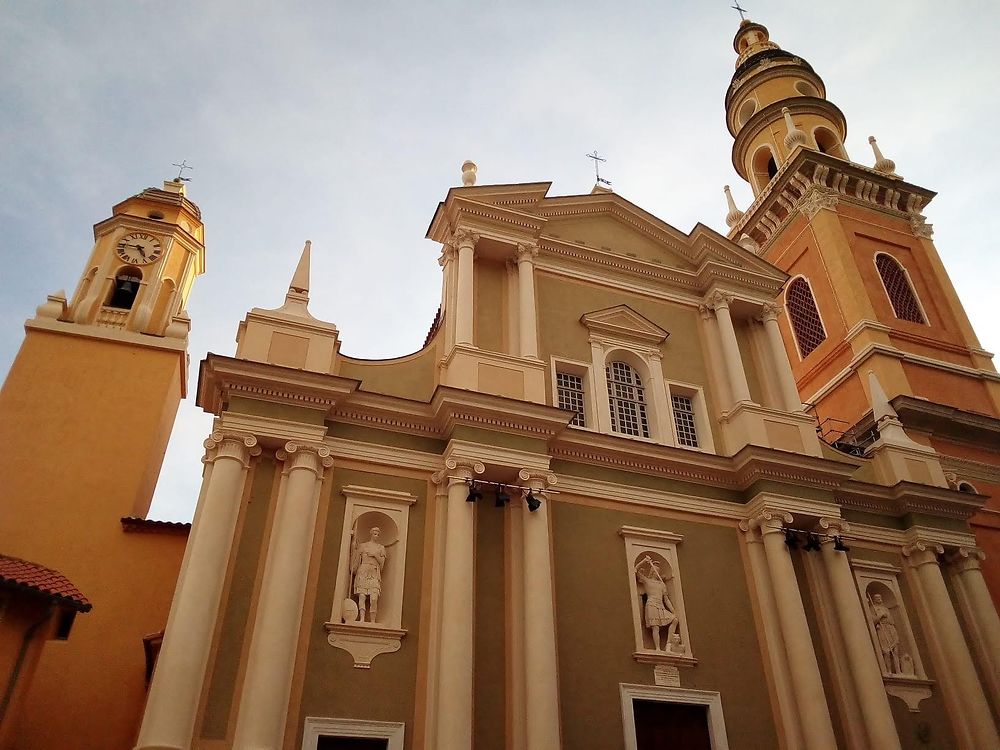
The Saint-Michel-Archange Basilica, 17th century — a masterpiece of Nice baroque architecture dominating the old town and the sea.
The Saint-Michel-Archange Basilica, built between 1640 and 1703, is the most imposing religious building in Menton. Its baroque trompe-l'oeil facade in ochre and white, its glazed-tile bell tower and its forecourt paved with black and white pebbles in geometric patterns constitute the iconic image of Menton. Inside, the baroque altars, paintings by Parrocel and the 17th-century organ merit careful attention. The basilica is the natural starting point for exploring the old town.
Nearby, the Vieux-Chateau Cemetery is one of the most poetic on the French Riviera. Perched on the rocky promontory 70 metres above the sea, it offers a 180-degree view over the Mediterranean and the old town rooftops. Russian aristocrats, Victorian diplomats and passing artists are buried alongside Menton families since the 19th century. The atmosphere is of rare serenity — and the view at sunset surpasses anything a postcard could promise.
The Rue Longue is the historic spine of the old town: a narrow medieval street running north to south through the entire quarter, lined with noble palaces, tiny churches and Gothic archways. Fishermen's houses have been converted into art galleries, jewellers' workshops and artisan boutiques. This is where Menton shows its true face, far from the tourist terraces along the seafront.
The Old Menton Covered Market (Place du Cap), open Tuesday to Sunday from 7am to 1pm, is where Menton reveals itself in full sincerity: stalls of local lemons and oranges, marinated olives, regional cheeses, cut flowers. Arrive before 9:30am to see locals doing their shopping and meet the producers who come directly from their farms in the hinterland.
Menton's Gardens: An Exceptional Botanical Heritage
Menton is a world capital of gardens. This is no exaggeration: the town possesses a concentration of remarkable gardens unique on the Riviera, the result of its exceptional microclimate and the passion of the aristocratic expatriates who settled here in the 19th and 20th centuries. You can spend an entire day visiting only Menton's gardens — and leave completely satisfied.
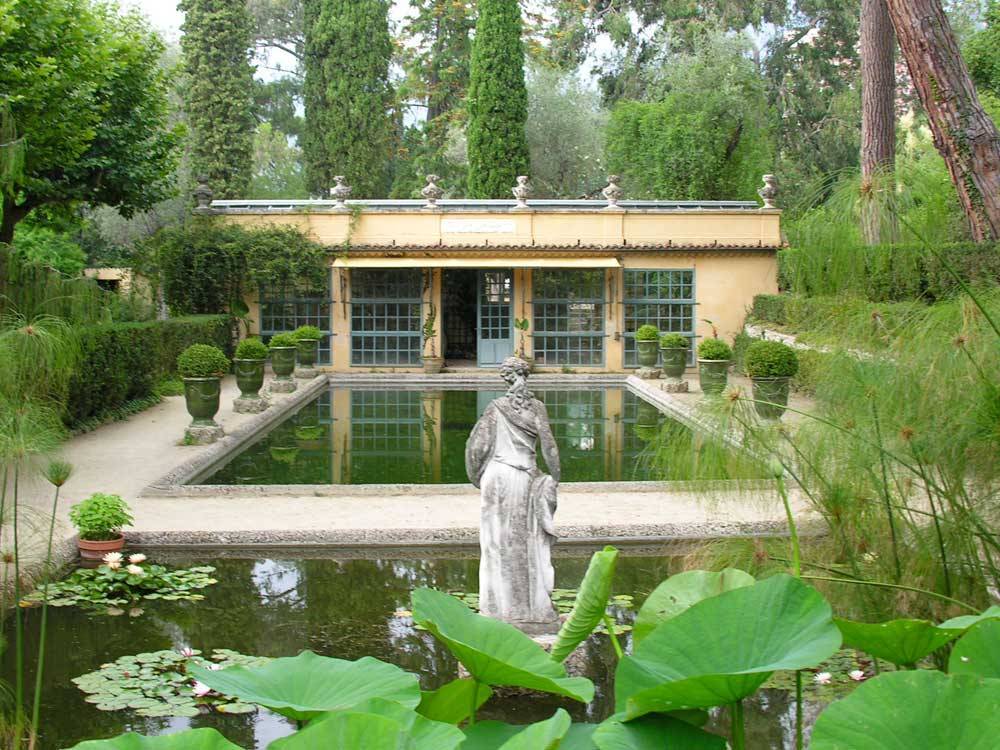
La Serre de la Madone: one of Europe's rarest gardens, listed as a Historic Monument, with its cascading terraces and plants from five continents.
La Serre de la Madone is the rarest and most sought-after of Menton's gardens. Created by British botanist Lawrence Johnston between 1924 and 1939, these terraced gardens perched at 120 metres altitude are listed as a Historic Monument. Their 2.5 hectares shelter plants from five continents: Mexican agaves grow alongside Japanese irises and rare Asian central tulips. Johnston was an obsessive perfectionist — he brought specimens back himself from expeditions to China, South Africa and South America. The result is a unique botanical work of art. The guided tour lasts 1h30 and must be booked on the Jardins de Menton website. Closed Mondays. Entry: 8 euros.
The Jardin Botanique Exotique Val Rahmeh is owned by the French National Museum of Natural History. It holds one of France's most complete collections of tropical and subtropical plants — over 700 species. Giant bougainvilleas, century-old Barbary figs and carnivorous plant collections make it both scientifically significant and visually spectacular. In season, the scents it releases are absolutely intoxicating. Open daily except Tuesdays. Entry: 6 euros.
The Jardins Bioves stretch 800 metres right through the heart of Menton, between the railway station and the old town. This is where the Lemon Festival sculptures are assembled each year. Outside festival season, royal palm trees, orange trees and exotic flower beds create a verdant corridor for a stroll between visits. Free entry.
The Palais Carnoles Garden deserves special mention: it is the largest open citrus garden in France. Adjacent to the museum of the same name, it holds 280 varieties of citrus in an 18th-century baroque park. In winter and spring, the flowering lemon trees perfume the air in a way you do not forget easily.
The Promenade du Soleil: Menton's Seafront
The Promenade du Soleil runs along the seafront for two kilometres, from the Plage des Sablettes in the east to the Bassin des Sablettes in the west. It is a boulevard-promenade in the Italian style, with its palm trees, pavement cafes and families playing volleyball facing the sea. The view of the old town from the promenade is the most-photographed image of Menton: the orange facades stepping up to the Saint-Michel bell tower, with snow-capped Alps as a backdrop on clear days.
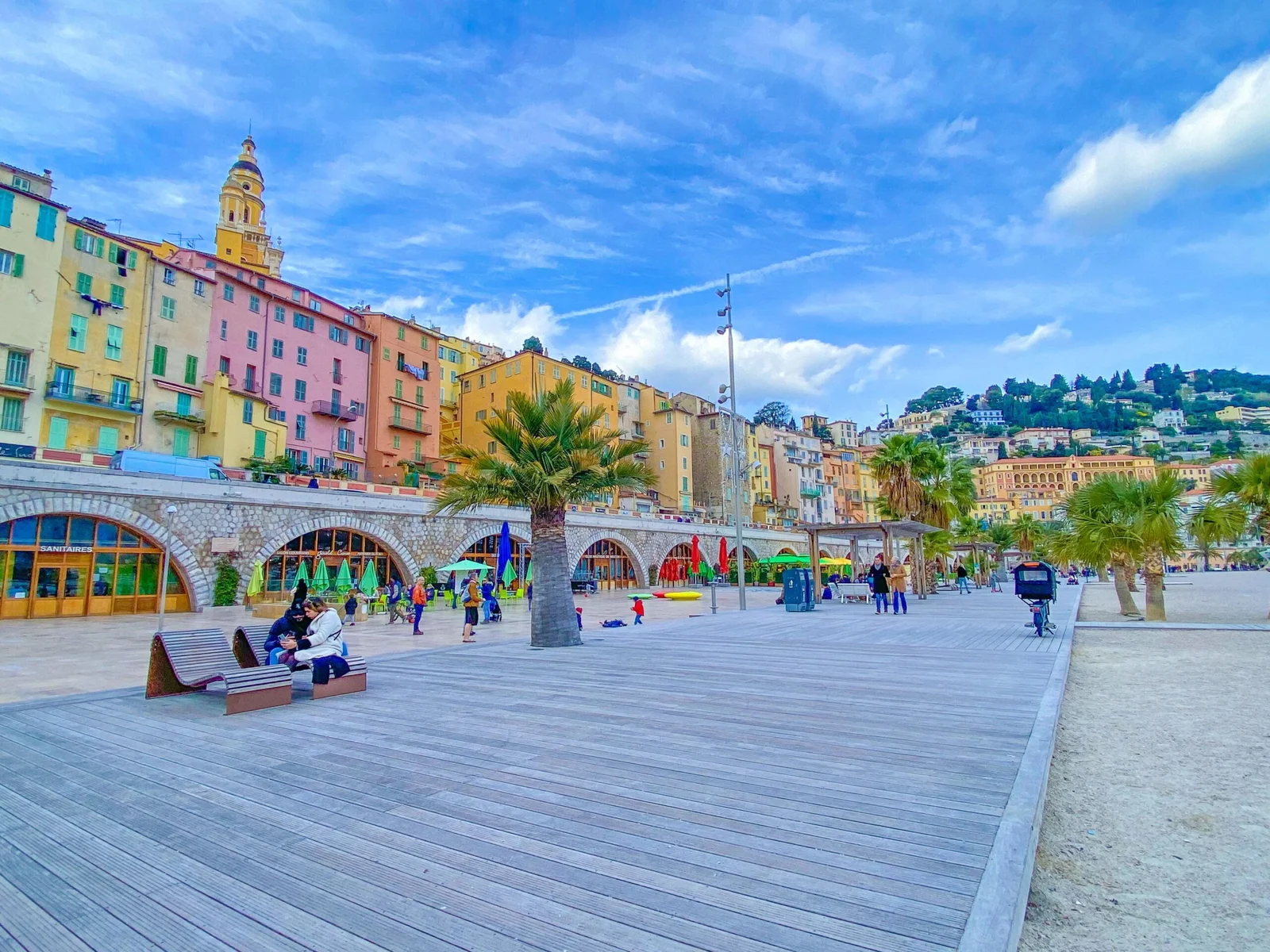
The Promenade du Soleil — two kilometres of seafront with the baroque old town as a backdrop.
Menton's beaches are pebble beaches — no fine sand. But the water is exceptionally clear thanks to the rocky seabed and the absence of river mouths. The Plage des Sablettes, opposite the old town, is the busiest but remains accessible outside July-August. The Garavan beach to the east (20 minutes on foot from the centre) is quieter with small isolated coves accessed by the coastal path. The Carnoles beach to the west is surrounded by a citrus orchard — one of the only beaches in the world where you can swim in the shade of a lemon tree.
Museums and Art in Menton
Menton has two museums that merit the detour and are often overlooked by hurried visitors.
The Musee Jean Cocteau — Collection Severin Wunderman is the city's major modern art museum. Inaugurated in 2011 in a contemporary building designed by architect Rudy Ricciotti (the same designer as Marseille's MUCEM), it holds the world's largest collection of Jean Cocteau works — over 1,800 pieces: drawings, paintings, tapestries, mosaics, pottery, photographs. Cocteau lived for long periods in Menton, which he loved for its light and tranquillity, creating some of his most intense works here. Open Wednesday to Monday, entry 8 euros.
Menton is the ideal city for working. It is not beautiful like a woman one courts — it is beautiful like a woman one has loved for a long time.
Jean Cocteau
Artist — on Menton
The Palais Carnoles Museum is less well-known but equally precious. Installed in the former summer residence of the princes of Monaco — an 18th-century baroque villa — it holds a remarkable collection of Italian and Flemish primitive paintings, Nice Renaissance canvases and works by Dufy and Sutherland. Free entry. The garden itself is worth the stop: 280 varieties of citrus in a park that becomes a fragrant paradise from December to March.
Menton's Gastronomy: Lemons, Barbajuans and Dolce Vita
Menton's cuisine is one of the great culinary surprises of the French Riviera. Caught between Nice cuisine and Ligurian Italian cooking, it has developed its own specialities you will find nowhere else with the same authenticity.
The Menton lemon — PGI-certified since 2015 — is at the heart of local gastronomy. Larger, juicier and less acidic than ordinary lemons, it enters everything: competition-level lemon tart, chicken tagine, preserved lemon pasta, welcome cocktails in hotels. Buy directly from local producers or at the morning covered market. The barbajuan is the speciality found only here and in Monaco — a fritter filled with blette greens and ricotta, fried and crispy, eaten walking through the old town lanes.
For restaurants, the Rue Longue and Place du Cap in the old town concentrate the best addresses: Franco-Italian trattorias, small fish restaurants, shaded terraces where time stands still. Key addresses: A Braisc for traditional Menton specialities, L'Ulivo for fresh lemon pasta, and Le Mirazur (three Michelin stars, book far in advance) for a gastronomic experience without equal on the Riviera.
Market tip: arrive early
The Vieux-Menton Market (Place du Cap) runs Tuesday to Sunday from 7am to 1pm. The best stalls — local lemons, mountain goat cheese, garden vegetables — are empty before 10am on busy tourist days. In July-August, aim for 8am to experience the market as a local Mentonnais would.
Menton Through the Seasons: When to Come?
Menton's exceptional microclimate means each season offers a different experience — and all are worth considering.
Winter (December-February): This is Menton's secret season. The tourists have left, but lemon trees are in full bloom. The Jardins Bioves begin filling with the first Lemon Festival sculptures from mid-December. Beaches are deserted, water too cold for swimming, but the promenades offer unparalleled serenity. Temperatures hold around 12-15 degrees C in the daytime. Restaurants in the centre offer their best value for money.
Lemon Festival (February-March): Three weeks of celebration around the lemon, with monumental sculptures in the Jardins Bioves, evening float parades and spectacular illuminations. In 2026, the festival runs from 8 to 23 March. Book accommodation and transfers months in advance — the town fills completely.
Spring (April-June): The ideal season. Gardens are in full bloom, the sea warms progressively (18-22 degrees C in June), crowds are moderate and accommodation prices are reasonable. This is when Menton's visual spectacle is at its most complete: pastel facades bathed in golden light, flowers everywhere, terraces opening up.
Summer (July-August): High tourist season. Beaches and the centre are lively, restaurants full in the evenings, heat sometimes intense (28-33 degrees C). But the sea is 25 degrees C and nights are mild. Garden visits work best early morning or evening. Logistics require more organisation — an additional reason to let our chauffeur handle your transfers.
Autumn (September-October): The sea is still warm (23-25 degrees C), light turns golden and raking, crowds withdraw gradually. One of the best periods for photographers and gastronomy lovers: restaurants are calm, markets overflow with seasonal produce, and gardens take on their autumn colours.
Day Trips from Menton: Monaco, Ventimiglia and the Hinterland
One of Menton's great strengths is its geographical position. It is simultaneously France's last town before Italy and the closest French town to Monaco. This double proximity opens easy and contrasting day trips.
Monaco in 15 minutes — The principality is 10 kilometres west of Menton. A half-day excursion allows you to visit the Casino de Monte-Carlo, the Rock and Princes' Palace, Port Hercule with its superyachts, and lunch on the Carre d'Or terraces. In high season, avoid driving: Monaco parking is a costly headache. A VTC private transfer from Menton to Monaco with our chauffeur is the seamless solution — he drops you at your first destination and can collect you whenever you choose.
Ventimiglia in 5 kilometres — Crossing the border on foot or by car to visit Ventimiglia's large Friday market is an experience in itself. This market is renowned throughout the Haut-Pays for its stalls of textiles, leather goods, Italian charcuterie and cheese, flowers and vegetables. It takes place Friday mornings on the Roya riverbanks. It is also an opportunity for lunch in Italy in one of the seafront trattorias for under 20 euros — pasta al pesto, fritto misto, local wine. The border is a mere formality in the Schengen area.
Sainte-Agnes and the hinterland — 17 kilometres north of Menton, the village of Sainte-Agnes claims the title of the highest coastal village in Europe (780m altitude). The view over the Mediterranean from its ramparts is breathtaking. The access road is narrow and winding — another good reason to let our chauffeur drive. The village of Castellar, at 800 metres altitude, is another well-preserved medieval gem with a central square shaded by century-old plane trees.
Roquebrune-Cap-Martin — Just 5 kilometres from Menton, this perched village offers one of the region's best-preserved medieval castles (10th century) and the ruins of Villa E-1027 by architect Eileen Gray, a monument of 20th-century modernism. Cap Martin itself is a protected peninsula with wild coastal paths of extraordinary beauty between Menton and Monaco.
Our Ideal Menton Weekend Itinerary
Here is how we recommend organising a weekend in Menton to make the most of every moment without rushing.
Saturday morning: market and old town (8:30am to 12:30pm) Start at the covered Vieux-Menton market around 8:30am for local lemons and breakfast barbajuans. Walk up to the Saint-Michel Basilica — allow 20 minutes of climbing but every step is worth it. Continue to the Vieux-Chateau Cemetery for the morning view over the sea. Descend through the old town lanes to the Promenade du Soleil. Coffee and pastries on a terrace of your choice facing the sea.
Saturday afternoon: gardens and museum (2pm to 6:30pm) After lunch, head to La Serre de la Madone (booking required, 1h30 visit). Follow with Val Rahmeh if energy allows (30 minutes). In late afternoon, the Cocteau Museum offers beautiful lighting on its collections. Dinner in the old town — try to book the night before.
Sunday morning: swimming and excursion (8am to 1pm) Early morning swim at Plage des Sablettes or the Garavan coves before 9:30am. Then an excursion to Monaco (15 min drive, half-day) or to the Ventimiglia Friday market if it is market day. Lunch on the Italian side for the full cultural experience.
Sunday afternoon: Palais Carnoles and departure (2pm to 5pm) Visit the Palais Carnoles and its citrus garden (free, open all day). Stroll back along the Promenade du Soleil. Depart by private chauffeur towards Cannes in the late afternoon — the drive back is the final chapter of the spectacle.
Practical Information for Your Stay in Menton
Accommodation: The best-located hotels are around the Promenade du Soleil and close to the old town. The Napoleon Hotel (4-star, sea view, parking) and the Hotel Lemon (boutique, old town, charm) are two reliable choices. Self-catering apartments in the old town on booking platforms offer a rare local immersion.
Parking: The old town has almost no parking. The underground Sablettes car park (beneath the promenade) is the closest, at 3 euros/hour in high season. The station car park is less convenient but cheaper. With a VTC private chauffeur, this problem disappears entirely.
Budget guide: Menton is generally less expensive than Monaco and comparable to Cannes outside peak season. Trattoria lunch: 15-25 euros. Garden entries: 6-8 euros each. Cocteau Museum: 8 euros. Market shopping: 10-15 euros for quality produce. Day budget (excluding accommodation and transport): 60-100 euros per person depending on activities.
Accessibility: The lower part of Menton (Promenade du Soleil, Jardins Bioves) is wheelchair accessible. The old town and terraced gardens involve stairs and significant changes in elevation. The Palais Carnoles and its garden are accessible.
Service Premium
Ready for your Menton weekend?
Plug-In Cannes drives you from Cannes to your hotel in Menton, and arranges your transfers to Monaco, Ventimiglia or the hinterland. Fixed rates, premium vehicles, zero logistical stress.
Frequently Asked Questions about Menton
How long does it take to visit Menton?
A full weekend of two days is ideal to see the essentials: old town, two or three gardens, a museum, and a day trip to Monaco or Ventimiglia. For a single day from Cannes or Nice, focus on the old town and Saint-Michel Basilica in the morning, then the Bioves Gardens and the Promenade du Soleil in the afternoon. In one well-organised day you will return feeling you have discovered an entire city. A week allows exploration of the hinterland, the perched villages of Sainte-Agnes and Castellar, and a full experience at Le Mirazur.
What is the best time to visit Menton?
Spring (April-June) is ideal: gardens in bloom, sea already warm, moderate crowds. The Lemon Festival in February-March is a unique experience but draws 200,000 visitors over three weeks — book well in advance. Autumn (September-October) offers a still-warm sea, beautiful light and reasonable crowds. The Menton winter is mild and flowering lemon trees create a unique poetic atmosphere. Summer is possible but requires planning visits early in the morning to avoid heat and queues.
How do you get from Cannes to Menton?
From Cannes, Menton is 55km along the A8 motorway (50 to 70 minutes' drive depending on traffic). The train exists via a connection in Nice (1h20 minimum door-to-door from Cannes station, longer from a Croisette hotel with luggage). Our Cannes to Menton private chauffeur transfer is the smoothest solution: leave from your hotel, arrive directly at your Menton address, fixed rate with no meter and no surprises. The chauffeur knows the Corniche roads and can stop for a photo if the scenery calls for it.
Is it easy to get from Menton to Monaco?
Yes — Monaco is just 10 kilometres west of Menton, about 15 to 20 minutes by car outside peak hours. The bus exists (route 100, 1.50 euros) but schedules are unreliable in high season. By train it is 12 minutes to Monaco-Monte-Carlo but the stations are far from tourist centres. The most convenient solution remains a private VTC chauffeur for a direct drop-off at your hotel, the Casino, or Port Hercule.
What are Menton's best beaches?
Menton's beaches are pebble beaches with remarkably clear water. The Plage des Sablettes (opposite the old town) is the most animated. Garavan beach (east, 20 minutes' walk from the centre) is quieter with small isolated coves accessed by the coastal path. Carnoles beach (west) is surrounded by a citrus orchard — a very special atmosphere. In July-August, sea temperature is around 25 degrees C and the water is beautifully transparent.
What is Menton's Lemon Festival?
The Lemon Festival is Menton's flagship annual event, held every February-March since 1934. Over three weeks, the town hosts exhibitions of monumental sculptures built from dozens of tonnes of lemons and oranges in the Jardins Bioves. Floats decorated with citrus fruits parade at night along the Promenade du Soleil with spectacular illuminations. In 2026, the festival runs from 8 to 23 March. Book hotels and transfers several months in advance — the event sells out weeks ahead.
What are the culinary must-tries in Menton?
Do not leave Menton without tasting: the barbajuan (a fritter filled with blette greens and ricotta, a local speciality found nowhere else), Menton lemon tart (PGI lemon, infinitely less acidic than ordinary lemons), Menton-style stuffed vegetables with herbs and ricotta, and pasta al limone in the old town restaurants. The morning covered market is the best place to buy local lemons, olives, artisan cheese and hinterland charcuterie. For lunch, try the trattorias just across the border in Ventimiglia for under 20 euros.
Is Menton's old town accessible on foot?
Yes, but note that the old town is built into a hillside: there are stairs, sloped lanes and fairly steep climbs to reach the Saint-Michel Basilica and the Vieux-Chateau Cemetery. Visitors with reduced mobility will find the lower areas (around the market and Promenade du Soleil) wheelchair accessible, but the heights of the old town are difficult without being able to climb stairs. Wear comfortable shoes.
How do you book Menton's gardens?
La Serre de la Madone requires online booking through the official Jardins de Menton website, especially in high season and at weekends. The Val Rahmeh Botanic Garden is walk-in (except groups). The Jardins Bioves are freely accessible year-round. The Palais Carnoles and its garden have free entry. Full garden budget (La Serre de la Madone + Val Rahmeh): 14 euros per person.
Is Menton suitable for families with children?
Absolutely. Menton is a gentle town without the frenzy of large resorts. Pebble beaches are supervised in summer, the Jardins Bioves have play areas, and the morning market is a vivid spectacle appreciated by children. The proximity of Ventimiglia (5km) makes for a fun cross-border "adventure". The Cocteau Museum runs children's workshops at weekends. The old town with its staircase-labyrinths is a great exploration space for curious children.
Maillage interne
Articles similaires
 guides
Chauffeur-Driven Car Hire in Cannes: Complete 2026 Guide
Hiring a car with a driver in Cannes is not hiring a car. It is buying back time, peace of mind and local knowledge. Formats, real 2026 prices, an honest comparison with standard rental and practical advice, from a chauffeur who drives here all year round.
guidesLocation de Voiture avec Chauffeur à Cannes : Guide Complet 2026
Louer une voiture avec chauffeur à Cannes, ce n'est pas louer une voiture. C'est acheter du temps, de la sérénité et une connaissance du terrain. Formules, tarifs réels 2026, comparatif honnête avec la location classique et conseils concrets : le guide d'un chauffeur qui roule ici toute l'année.
 events
All4Customer Meetings Cannes 2026 : Transport & Chauffeur Privé
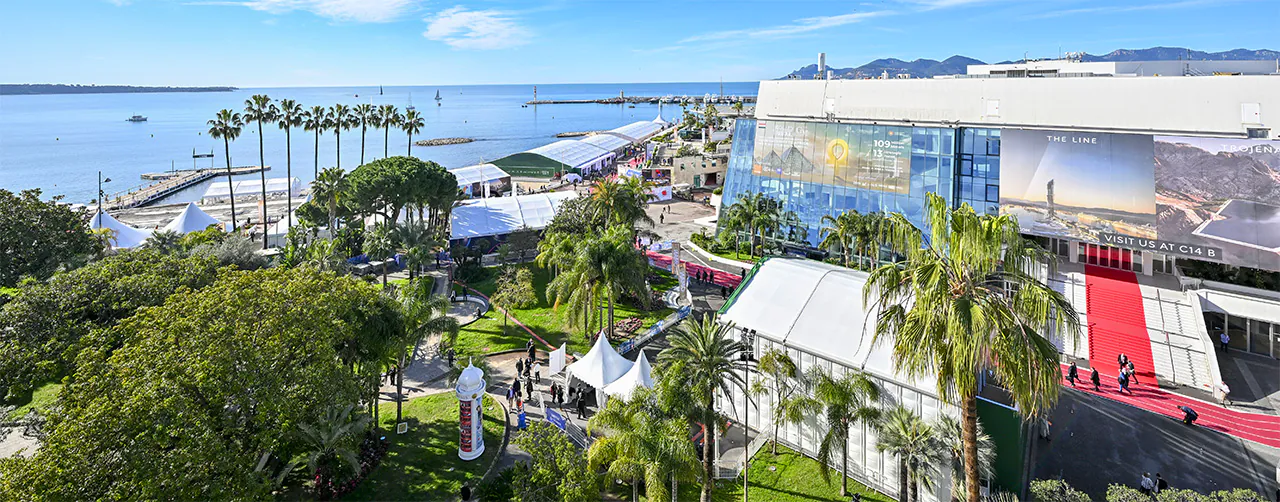
Du 15 au 17 septembre 2026, le Palais des Festivals de Cannes accueille All4Customer Meetings, le rendez-vous business de l'expérience client et du digital. Format one-to-one, agendas minutés, décideurs pressés : voici le guide transport complet — transferts aéroport, chauffeur privé et mise à disposition — par un partenaire qui roule sur la Riviera toute l'année.